


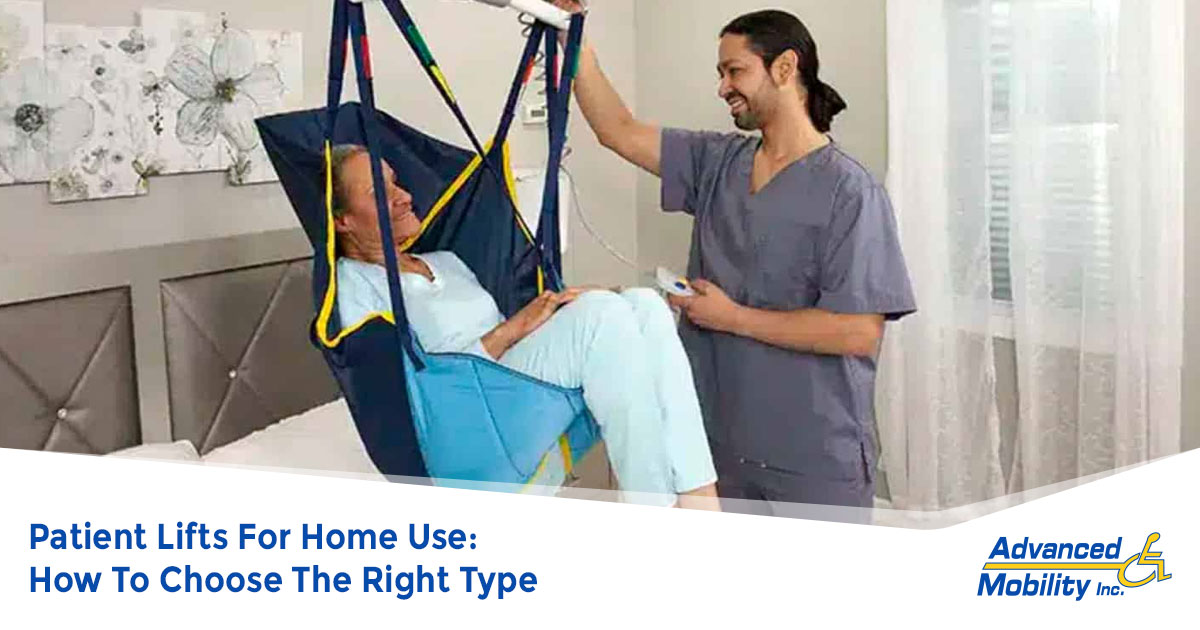
Caring for a loved one at home can be a very rewarding experience, but one that can become physically demanding when the individual has mobility challenges and requires extensive assistance. Families throughout South Florida are realizing that patient lifts are becoming an essential device when caring for loved ones at home.
Patient lifts for homes dramatically improve safety, reduce caregiver strain, and provide confidence and Independence during transfers. However, with so many patient lifts available, family members and caregivers are feeling overwhelmed with choices. Understanding the different types of patient home lifts and the factors involved in selecting one can help you make an informed decision.

What Is A Patient Lift?
A patient lift for home is a mobility device specifically designed to assist with transferring an individual from one position to another.
Patient lifts may be used to assist individuals with mobility challenges in areas such as:
- From a bed to a wheelchair
- From the wheelchair to a toilet
- From a wheelchair or chair into the bed
- Transfer between various seating surfaces
- Helping the individual up from the floor after a fall
Using a lift assists to reduce the physical strain associated with lifting and transferring individuals who have difficulty standing, walking, and/or bearing weight.
Why Are Patient Lifts Important In Home Care?
With more and more individuals choosing to age in place, family caregivers are often relied on to provide care. While having the best intentions, they quickly discover that manual transfers can be both physically challenging and often unsafe.
Patient lifts assist any size individual who has difficulty transferring from one area to another.
Reasons patients may require a transfer lift include:
- They have general weakness and cannot bear weight
- They have problems with balance
- They have neurological conditions that impact balance and/or mobility
- They fatigue very easily
- They are injured or recovering from major surgery
The benefits of having a patient lift in the home are numerous.
Some of the benefits may include:
- Reduced physical strain on the caregiver
- Lower risk of injury to the individual and caregiver
- Increased comfort during transfer
- Better positioning after the transfer
- Enhanced confidence during the transfer
Who Benefits From A Home Patient Lift?
There is a wide range of individuals who benefit temporarily or long-term from a patient home lift.
Examples of individuals who would benefit include:
- Seniors or other individuals with limited mobility. Some individuals may also have strength, balance, and endurance limitations. Patient lifts assist with safe transfers, allowing these individuals to remain at home.
- Individuals recovering from surgery such as hip replacements, knee replacements, major abdominal surgery, or spinal surgery may have temporary limited mobility that makes transfers difficult.
- People living with neurological conditions like multiple sclerosis, Parkinson’s disease, ALS, spinal cord injuries, or individuals who have had a stroke.
- Family/caregivers benefit by having a device that protects them from physical strain and injury.
Why Professional Assessment Is Essential
One of the most important decisions a family can make is to select the appropriate patient lift system. Not all lift systems are equal, and not every lift will work for every individual. An assessment assists individuals in making the right decision, and, apart from budget considerations, the outcome will depend on multiple factors.
These include:
- The individual’s current mobility
- The individual’s cognitive status
- The individual’s weight-bearing ability
- Medical conditions
- Long-term care goals
- The home layout
- Caregiver availability
- Maintenance requirements
The assessment is comprehensive; families should never attempt to determine lift requirements on their own. The assessment is done by professional and qualified healthcare and mobility professionals to ensure that the safest and most appropriate solution is selected.
The physical environment also plays an important role in lift selection.
Factors that may influence a recommendation include:
- The room size – small rooms may limit maneuverability of certain lifts.
- The width of the doorway – narrow doorways may affect accessibility between rooms.
- Flooring – the type of flooring may impact how easily the equipment can be moved from one room to another.
- Bathroom accessibility – if the lift needs to be in the bathroom, accessibility within the room is essential.
- Workspace for caregivers – is a consideration, essential to providing safe care.

The Types Of Patient Lifts
Patient lifts fall into three primary categories. Understanding the various lifts can help families better understand the recommendations they may receive.
The three main types of patient lifts are:
Mobile Floor Lifts
These are the most common patient lifts used in a home care setting. These lifts are mounted on wheel bases and can be moved around the home where needed. A sling supports the individual while the lift gently raises and transfers them between locations.
The benefits of floor lifts include:
- They are very versatile and can be used in multiple rooms.
- No major home renovations are required.
- They can accommodate a wide range of transfer situations.
- They are suitable for a wide range of mobility challenges.
Sit-To-Stand Lifts
Sit-to-stand lifts are designed for individuals who can still bear weight. Rather than lifting the person completely, a sit-to-stand lift will assist them into a standing position before transfer.
The benefits of a sit-to-stand lift include:
- They encourage the individual to participate in the transfer.
- They promote mobility when appropriate.
- They are faster than full-body lifts.
Ceiling Track Lift Systems
Ceiling tracks are mounted to the ceiling to move individuals safely between locations. These systems are commonly found in bedrooms, bathrooms, and other areas frequently used by the individual.
The benefits of ceiling lifts include:
- There is no floor base to maneuver.
- They provide excellent support when there is a single caregiver.
- The transfers are usually very smooth.
- They can maximize existing floor space.
Patient Home Lift FAQs
Families often have questions about home patient lifts. Some of the most common questions include:
Are Patient Lifts Safe?
If a proper assessment has been done and the lift is used according to professional guidance, patient lifts provide a safe method of assisting with transfers. Modern patient lifts often incorporate numerous safety features that are designed to keep the user and caregiver safe.
Can Patient Lifts Be Used By One Caregiver?
Patient lifts can be used with one caregiver, but the caregiver requirements will be dependent on:
- The individual’s condition and mobility limitations
- The lift that is selected
- Healthcare recommendations
Will A Patient Lift Fit Into My Home Without Renovations?
Many patient lifts are designed for residential homes. To determine whether a specific lift will fit into your home, a professional home layout assessment is required.
Is One Type Of Lift Better Than Another?
Professional guidance is important when comparing lift options. The best choice will depend on:
- Individual and caregiver requirements
- The home layout
- Long-term goals
Will I Get Training On How To Use The Lift?
Yes. Before using the lift, caregivers receive training to maximize safety and patient comfort.

Choose The Right Home Patient Lift With Professional Guidance From Advanced Mobility
Selecting a patient lift can be overwhelming, especially with so many choices available. At Advanced Mobility, we understand that every family’s situation is unique, so our experienced team works closely with individuals, healthcare professionals, therapists, caregivers, and family members to identify a lift that will improve safety, comfort, and independence.
We offer high-quality patient lifts and have a variety of models, including:
- Golvo 9000
- Viking Mobile Lift
- Uno 102 EE
- Liko M220
- Liko M230
- Sabina II EE Sit-To-Stand Lift
Our goal is always to provide high-quality equipment that helps families. For a professional assessment and information about our patient lifts, contact our team at 954-888-9292 today.